


The Q1 2026 Citizens Advice energy ratings are the second quarter under the revised methodology, and the first clean quarter-on-quarter comparison under the new rules.
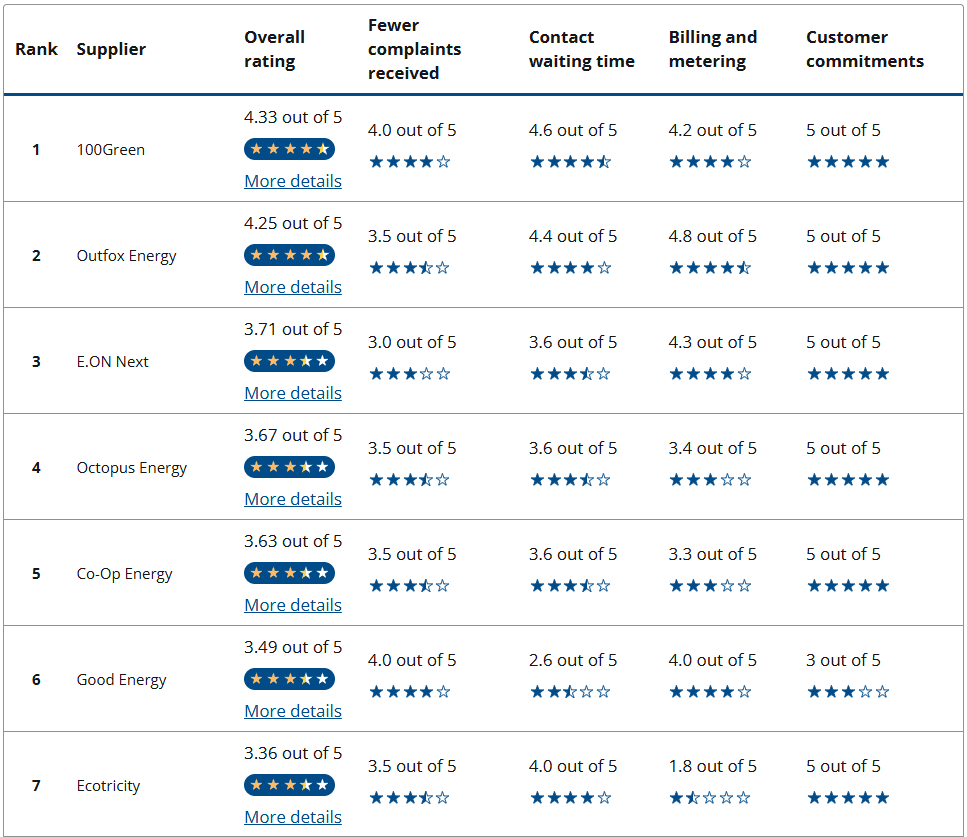
Source: Citizens Advice, Q1 2026 star rating.
If you skim the top of the table you might think you’re looking at a chaotic shuffle. 100Green from 6th to 1st. Ecotricity from 1st to 7th. Look underneath and it isn’t chaos. It’s the new methodology surfacing things the old one couldn’t.
Two moves worth looking at closely.
100Green’s jump is structural, not operational. In Q4 2025 they scored 0 out of 5 on customer commitments. In Q1 2026 they scored 5. Energy UK confirms 100Green joined the Energy Switch Guarantee in Q1 2026, and their own site now shows them as a 2026 signatory to the Vulnerability Commitment. Two voluntary scheme sign-ups, worth 5 points on that dimension, and five ranking places on the overall table. Their operational scores for complaints, contact wait, and billing barely moved.
Ecotricity’s fall is operational, and specifically about billing. Their overall score dropped from 3.93 to 3.36, and the entire fall is concentrated in one metric. Billing and metering went from 3.3 to 1.8. Complaints and contact ease held roughly steady. When the new methodology was introduced in Q4 2025, billing and metering was a new measure. One quarter later, it’s starting to bite, and Ecotricity’s fall is what “bite” looks like for a supplier whose billing operation isn’t as strong as its customer-facing service (as measured by Citizens Advice).
At the bottom of the table, TruEnergy sits at 1.38. Worth flagging that TruEnergy is primarily a B2B specialist with a domestic sideline (via the Huddle Utilities brand). A consumer-facing methodology will always sit awkwardly with a business built for landlords, multi-site operators, and utility-splitters. Their position is a business-model mismatch story more than an operational one.
The persistent problem at the bottom is Utilita. Their complaints score is 0.5 out of 5, the lowest single-metric score in the whole table, and they’ve been in this position quarter after quarter. Everything else could improve tomorrow and it wouldn’t make a material difference to their overall position. That’s a structural problem, not a bad quarter.
When a measurement framework updates, three things happen. The rankings reshuffle. The reasons for the reshuffle become visible. And the operators who understand what’s actually being measured start responding.
If you’re a service leader whose internal metrics haven’t been updated in three years, you’re probably measuring last decade’s failure modes. The Citizens Advice methodology has just moved on. The suppliers who read it well will now know exactly which levers to pull. The ones who read it as a ranking will still be optimising for a scorecard that doesn’t reflect what customers actually get.
If you’re in that position, this is where I can help. I’ve spent 30 years running and consulting on customer service operations across energy, telecoms, and regulated markets. If your metrics feel like they measure the wrong things, or you have the data and no clear way to make sense of it, get in touch.
The new methodology has done its job. It’s now the operators’ turn.